
What is car clay? Car clay is a specially designed polishing compound containing unique polishing particles…

Polymer glove – is it worth it?

Is it worth using a polymer glove to clean paint?

In-depth cleaning Paint is the basic stage of work when applying waxes or other protective coatings to the bodywork. During the initial car wash, even with active foam, we will not remove all the dirt. Many of them penetrate deeply into the structure of the varnish. And although they are invisible to the eye, they will not allow the wax or coating layer to bond properly with the varnish. As a consequence, the treatment will be unstable, the coating will not fulfill its role, and we will waste time and money. So how to thoroughly clean the paint?
Claying the bodywork – a method of cleaning the paint
Before waxing or applying other products protective coatings on the body, the paint should be properly clayed. Claying of the bodywork This is a treatment that should be performed regularly 3-4 times a year. It involves thoroughly cleaning the paint from any dirt that has penetrated into the micro-crevices and cannot be removed by traditional washing. These include tar, dried insects, dust, tree sap, and even minerals from water or acid rain. These dirt stick strongly to the body and penetrate the structure of the paint. Shampoo or even active foam cannot remove them. For thorough cleaning, claying of the car is necessary.
How to clean your car, i.e. what to use instead of clay?
Traditional claying involves the use of clay, i.e. a mass resembling plasticine. The paint cleaning process involves rubbing a piece of plastic mass over the bodywork covered with an appropriate lubricant. During the treatment, the clay collects dirt that has penetrated the paint, effectively removing it. It can be used on bodywork, windows and rims.
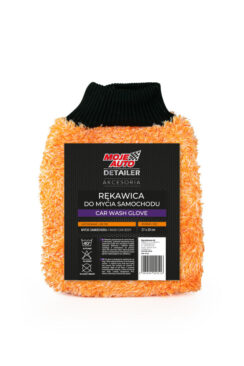
You can choose from clays with different degrees of hardness and, therefore, different aggressiveness. The procedure is tedious and requires precision and experience. Not everyone likes working with clay, and some people are afraid that it may scratch the paint. Of course, when used properly, it is completely safe for cleaned surfaces. Nevertheless, there are alternative solutions for it. It belongs to them POLYMER GLOVE FOR CLEANING PAINT. This is a tool that will effectively replace traditional clay and help thoroughly clean the paint even for less experienced drivers.
How does a polymer glove work?
You already know what claying paint involves using traditional clay. It's time to learn about an alternative, i.e. how a polymer glove works, which is also suitable for cleaning paint. Thanks to the polymer layer, the glove perfectly removes remains of insects, tar, resin and even traces of glue or asphalt. It copes perfectly with stubborn contaminants that have penetrated deep into the paint and cannot be removed by regular washing.
Thanks to the use of high-quality polymer during production, it is gentle on cleaned surfaces. It does not damage the paint and is safe to use. All thanks to the polymer layer, which is flexible enough to remove dirt that has penetrated the structure of the paint. At the same time, it was also durable enough to ensure repeated use.

Why is it worth using a polymer glove instead of traditional clay to clean paint?
Traditional clay requires skill in use. That's why detailers often use it when cleaning paint, windows and rims. In the case of the latter, it is irreplaceable due to its plasticity. Nevertheless, the polymer glove is becoming an effective contender in this role today. It is larger and therefore provides a much wider working area. It is also much easier and faster to use compared to traditional clay. Moreover, the polymer glove is always ready for use. Just moisten the surface with lubricant and you can start working straight away. Traditional clay must first be divided and shaped appropriately. With polymer glove process decontamination varnish is definitely faster, more convenient and simpler.
What is the process of cleaning paint using a polymer glove?
Clay in the form of a polymer glove is a solution for people who value comfort and speed of action. Its use requires the application of the basic principles of claying. Therefore, we must remember to always keep the clayed surface wet. It is best to use a special lubricant to ensure proper slippage of the glove.
Of course, we always carry out the claying process on a previously washed, rinsed and dried car. Then we apply lubricant to the panel in an amount that ensures comfortable sliding. We put on a polymer glove and start the cleaning process by moving our hand over the paint and windows without excessive pressure. It is extremely important to use transverse and longitudinal movements, never circular ones. After all, a polymer glove works just like clay. To avoid possible scratching of the paint with accidental dirt, wash the glove regularly in water.
Z polymer glove just as we work with clay in batches, we try to clean the varnish one element at a time. After finishing the work, simply rinse the glove thoroughly in water, dry it and store it away. The product will be ready for the next cleaning.
A polymer glove is a reusable tool that is highly durable and extremely effective. It is essential for cleaning the paint.